Dooly
Our Design System for continuity, and Operational Rules for reinforcing operational standards.
Head of Design (Senior Leadership Team) · 2021–2023 · 7-person design team across Product and Marketing
Built the Product Language design system, established the Quality Bar as the operational standard, and shipped the user journey map that became cross-functional alignment infrastructure across Product, Engineering, and Design.
In this project: Product Language · The Quality Bar · The User Journey Map
Product Language
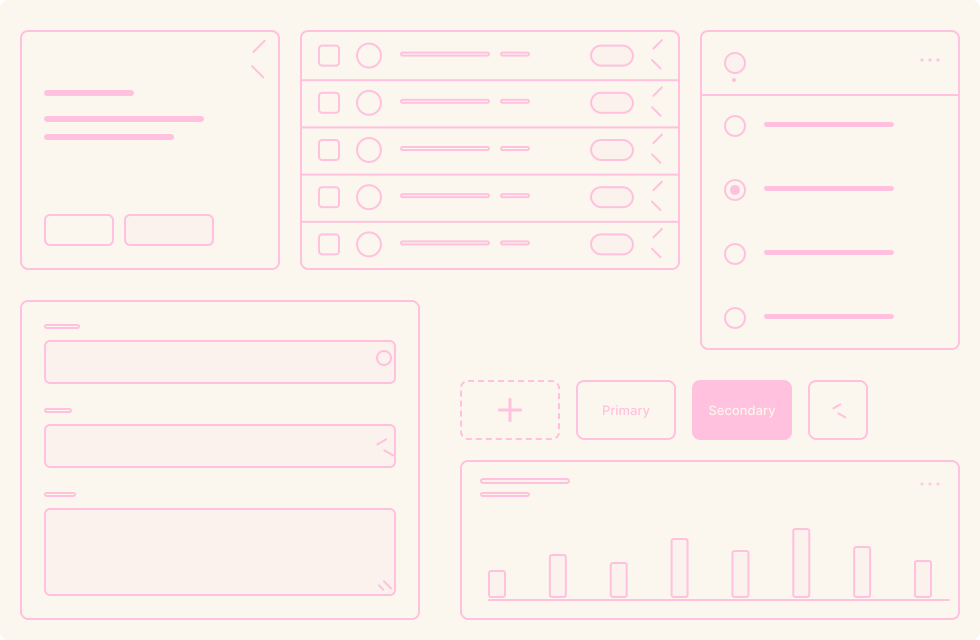
Built a design system so seven designers could ship across four workstreams without style drift.
The problem
strong designers, no shared language — no tokens, no component library, and no consistent patterns. Quality depended on individual effort, not the system.
What shipped: Product Language (design system).
- Tokens for color, type, spacing, and motion
- Components + patterns built from real product screens (not abstract examples)
- Coverage for dense data, configuration flows, and collaboration surfaces
Why it worked
it shipped alongside product work, so adoption wasn't optional. Engineers and designers pulled from the same library, and consistency became the default.
The Quality Bar
Made quality repeatable — not dependent on individual stamina.
The gap
the design system covered what to ship, but not how to make decisions when things got messy.
What I built: The Quality Bar — Tools, Rituals, and Mechanisms that combine to make Quality.
- Principles to resolve tradeoffs under pressure
- Weekly critique format to keep quality visible across workstreams
- Growth framework to make expectations and leveling clear
- Work-back planning to pull design upstream before engineering committed
Why it worked
the bar showed up in PM and Engineering reviews because it was embedded in planning + critique — not kept as "design-only" guidance.
View the Design Operations Framework →
The User Journey Map
Created a single-page map that aligned Product, Engineering, and Design around the user's core actions — not team boundaries.
The problem
roadmap conversations started with "who owns this?" instead of "where does this fit in the sales rep's workflow?" Product streams and team boundaries had collapsed into the same conversation, and the user had vanished from it.
What shipped: a one-page user journey map of the deal cycle. Six lifecycle stages, the AE's actions at each, and the moments that actually advance a deal — kept to a single page so it stayed scannable in standup and critique.
The deal cycle, the rep's view
"where in the workflow does this product stream actually live?"
Why we anchored on the AE. The AE touches every stage and inherits work from every other role. Building the system on the AE first meant every other persona's view — CSM, BDR, Sales Manager — could be derived from this one, instead of forcing six parallel frames into the same roadmap conversation from day one.
Where the AE actually spends their day
many small actions; a handful of moments that decide the deal
Why it worked
It became a shared reference for roadmap, scope, demo flow, and critique — a neutral object that no single team "owned."
What I'd do differently
- Opened critique to PM and Engineering from week one. The cross-functional value was obvious in hindsight. Gating critique to the design team for the first several months left leverage on the table for no reason but inherited habit.
- Built the user journey map in the first 60 days. Every roadmap conversation would have been cheaper from day one. I delivered it mid-tenure — too late for the alignment work it ended up doing.
- Tied the Quality Bar to product KPIs explicitly from the start. Adoption came, but slowly. Connecting bar-raising to activation and adoption metrics would have accelerated cross-functional buy-in by months.
Full case study (PDF) — in production
Next Project
Locus →