Most of what's called "building with AI" is prototyping

Your feed is full of it. “I built a full SaaS app in one afternoon.” “10 prompts to a working product.” “No code, no team, ship today.”
Go do it. Seriously. Build the thing. I’m not here to talk anyone out of experimenting with AI. I build with AI every day. But let’s be honest about what most of that content is actually selling — and what the person holding the result is actually holding.
It’s a prototype. A good one, sometimes. But a prototype.
The pitch
The “build with AI” content ecosystem runs on a specific trick: collapsing the distance between a demo and a product. A prompt generates working-looking code. A screenshot proves it runs. A post frames the whole thing as a finished outcome. The engagement comes from making product development look like it takes an afternoon, and the implicit promise is that you can skip the slow, boring parts.
What gets skipped is everything that makes a product a product. Verification. Architecture. The ability to change something six weeks from now without breaking three other things. A mental model of what you actually built and why.
Andrej Karpathy — the person who coined “vibe coding” — acknowledged it works for throwaway weekend projects. That qualifier gets cut from the viral clip every time.
What doesn’t scale
A prototype demonstrates a possibility. A product has to survive contact with real usage, real data, real change over time, and real people other than the builder trying to understand what’s happening.
Most AI-generated output fails at the transition. Not because the model is bad — because the surrounding infrastructure was never built. There are no specs that explain what the system is supposed to do. There’s no verification that it actually does it. There’s no architecture that lets someone maintain it when the requirements shift.
The data is catching up to the hype. RAND research found that 70–90% of AI projects never scale beyond the pilot phase. A Veracode study found that 45% of AI-generated code introduces security vulnerabilities — not minor bugs, but critical flaws. Over 60% of developers report spending more time debugging AI-generated code than writing it would have taken. And 42% of companies abandoned most of their AI initiatives in 2025 — more than double the rate from the year before.
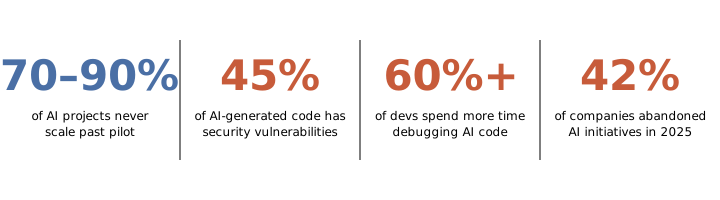
The pattern is consistent: fast prototyping, then a steep drop-off once teams need integration, security, and governance.
Alex Turnbull, founder of Groove, spent a year building two enterprise AI products and put it plainly: vibe coding didn’t get them there. Only real engineering did. Raymond Kok, CEO of Mendix, called it a short-term con with limited long-term gains.
The part that should scare you
It’s not that the prototype doesn’t work. It’s that you don’t know what you have.
When someone says “I built a product in 10 prompts,” the honest version is usually: “I generated something I can’t fully explain, using architecture I didn’t specify, with failure modes I haven’t mapped.” That might be fine for a weekend experiment. It’s terrifying as a foundation.
Two outcomes from here, and neither is good:
Dead end. The prototype works at demo scale. You try to add users, handle edge cases, change the data model, integrate with something else — and discover the architecture can’t support it. You’re not iterating. You’re starting over, except now you’ve already told everyone it works.
Untenable. The prototype actually grows. People use it. And now you’re maintaining a system you can’t debug, can’t explain to another builder, and can’t modify without cascading breakage. You didn’t skip the hard part. You deferred it, and it compounded.
What actual product building looks like
I’m building a product right now as a solo founder, and AI is central to how I work. I’m not anti-AI. I’m anti-pretending infrastructure doesn’t matter.
The difference between my process and “10 prompts to a product” is everything the pitch never mentions. A build plan with 17 epics. Ticket specs with explicit acceptance criteria. Decision authority levels so I know who decided what and why. Change control so modifications don’t silently break prior work.
That’s not bureaucracy. That’s how you build something you can still understand in three months. Something another person could pick up. Something that can change without collapsing.
The unsexy version of building with AI is: write real specs, verify real output, maintain real architecture, and use the model’s speed to do more of the hard work — not to skip it.
The content is the product
Here’s the part nobody in your feed will say: for most of the people posting “build X in 10 prompts,” the content is the product. The app isn’t the business. The post is. They’re selling tools, courses, audiences, or personal brands. The demo is the deliverable. It was never supposed to survive past the screenshot.
That’s fine. It’s marketing. But if you’re the person who saw that post and thought “I should build my startup this way” — you’re the customer, not the founder.