Responsibilities × Activities × Outputs

Titles sound precise until you try to use them.
I’ve held some version of “Head of Design” across multiple companies, and the words meant something different every time. At one company it was a strategic seat — shaping product direction, influencing the executive team, building organizational systems. At another it was still heavily hands-on — leading craft, shipping work, operating as a player-coach. Same title. Completely different jobs.
That gap became a real problem when I was trying to explain my work to people. In interviews, in portfolio conversations, with founders evaluating fit. I’d say the title and watch them nod, but I could tell they were mapping it to whatever version of the role they’d seen before. The title created a false sense of shared understanding that made the actual conversation harder.
I’m not the only one noticing. The whole industry is starting to admit that titles don’t describe work very well — though the responses vary wildly.
Everyone agrees titles are broken
In January 2026, Deloitte announced it was overhauling job titles for all 181,500 US employees, replacing the traditional consultant progression with “job families” and “sub-families” that better match the actual work being done. Their own research backs the move: in a global survey, 71% of workers said they already perform work outside their job description, and only 19% of executives thought traditional job structures were the best way to create value.
Six months earlier, Shopify’s chief design officer Carl Rivera dropped “UX Designer” as a title entirely, flattening the role to “Designer.” His argument was that AI now handles baseline usability, so the designer’s job is taste and intuition — and the old title was anchoring people to a narrower definition of the work.
Unilever has been moving in a similar direction, with their head of HR for Australia and New Zealand explaining that the company is starting to think about each role as a collection of skills rather than a job title.
These are big moves. They’re also solving different problems in different ways — Deloitte is recategorizing, Shopify is flattening, Unilever is decomposing into skills. What none of them quite provides is a practical tool for an individual person or team to make a specific role legible right now, without waiting for an enterprise-wide transformation.
That’s what I ended up building for myself.
Three layers that do different work
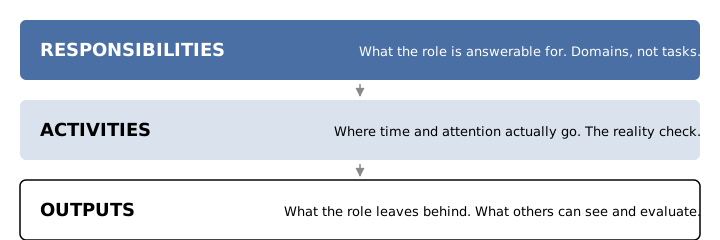
Instead of arguing about what a title should mean, I started breaking roles into three layers: what someone is responsible for, what they actually spend time doing, and what they produce that other people can see and evaluate.
Responsibilities are what the role is answerable for. Not tasks — domains. “Design quality across the product” is a responsibility. “Review the checkout flow” is an activity. When these get confused, leaders end up accountable for outcomes they never have time to influence because their calendars are consumed by activities that belong one level down.
Activities are where time and attention actually go. This is the layer most people skip when describing a role, and it’s where mismatches do the most damage. A leadership role with strategic responsibilities but operational activities will produce burnout. A senior IC role with execution activities but no ownership of outcomes will produce disengagement. The activity layer is the reality check on whether the role is designed to be possible.
Outputs are what the role leaves behind. Decisions, artifacts, systems, deliverables — things other people can point to. When outputs aren’t defined, performance conversations turn political. Clear outputs make evaluation honest.
What the whiteboard showed
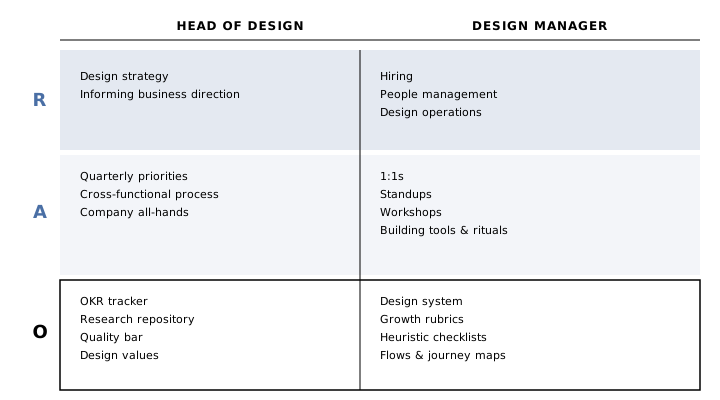
I first drew this out on a whiteboard while leading a design org, mapping two roles side by side: the Head of Design seat I was in and a Design Manager role on the same team. Same discipline, completely different shape.
The Head of Design column had responsibilities like design strategy and informing business direction. Activities were quarterly priorities, cross-functional process, company-wide all-hands. Outputs were an OKR tracker, a research repository, a quality bar, design values.
The Design Manager column had responsibilities like hiring, day-to-day people management, design operations. Activities were 1:1s, standups, workshops, creating tools and rituals to drive quality. Outputs were a design system, growth rubrics, heuristic checklists, flows and journey maps that guided direction.
Putting them side by side made two things immediately obvious. Career progression between the roles wasn’t about seniority — it was about which layer carried the most weight. And anyone looking at both maps could tell you what each role actually was in a way the titles alone never communicated.
Why this matters more than renaming
Deloitte’s solution is structural recategorization at enterprise scale. Shopify’s is philosophical simplification. Both are legitimate responses to a real problem. But neither gives you a way to sit down tomorrow and make a fuzzy role clear.
R×A×O works at the individual level. It doesn’t require a company-wide initiative or a title overhaul. It works for a hiring conversation, a growth review, a scope negotiation, or a founder trying to explain what they actually do all day.
Hiring gets clearer because you can tell whether you’re looking for someone who owns outcomes, executes activities, or produces specific artifacts. Most job descriptions smear all three together and hope the right person self-selects.
Growth conversations improve because the difference between a current role and a next-level role becomes concrete instead of hand-wavy. Instead of “we need you to be more strategic,” you can show which responsibilities shift, which activities change, and which outputs the next level requires.
Cross-functional friction becomes diagnosable. A PM and a designer who keep colliding usually have a responsibility overlap, an activity duplication, or an output gap. The frame turns friction into a structural question with a structural answer.
Start with the work, not the title
If a role feels fuzzy — yours or someone else’s — skip the title debate.
What is this person actually responsible for? What do they repeatedly spend their time doing? What do they need to produce that others can see and rely on?
If the answers conflict with each other, the role is broken before anyone sits in it. If they align, the title is just a label. Call it whatever you want.