AstrumU — Making the Vision Tangible When the Story Doesn't Exist Yet
Led design vision and product strategy for an AI data platform — building the artifact that aligned the company, choosing the use case that focused it, and creating the team and frameworks that shipped it.
Role
Head of Design (hybrid design–product capacity)
Type
AstrumU
Timeline
2024–2025
Team
4-person design team
Overview
AstrumU was building an AI data platform to power a skills-based economy — ingesting transcripts, resumes, and military records, translating them into verified skills profiles, and connecting those profiles to workforce data. The technology worked. But the company had a translation problem no amount of engineering could solve.
Different teams interpreted the platform differently. A skills heatmap concept was gaining momentum — an aggregate visualization of skills density across populations — but it couldn't answer the question that mattered: so what? The gap wasn't in the technology. It was in the product narrative.
The goal: Make the platform's value tangible — not through strategy documents, but through something people could see, react to, and align around. Then use that clarity to focus on the use case with the broadest impact.
Role
Head of Design (operating in a hybrid design–product capacity)
My title was Head of Design, but the role required operating at the strategy layer alongside senior leadership. Design owned vision, Product owned prioritization and execution, and the gap between those two needed someone working in both spaces.
- Built and managed a 4-person design team; established rituals, standards, and scalable processes
- Founded AstrumU's first qualitative research practice, embedding user discovery and usability testing into every sprint
- Led AU Labs — a sandbox environment that became the primary mechanism for aligning the company around what the platform actually did
- Defined the product catalog and go-to-market readiness frameworks in partnership with Product leadership
- Introduced OKR, KPI, and Product Canvas frameworks to connect design and product work to measurable outcomes
- Created a Product Readiness Tracker adopted across departments for roadmap visibility and launch planning
Approach
Starting with the crux: what does this platform do for one person?
The internal conversation was dominated by the knowledge graph and skills taxonomy — the infrastructure layer. The most visible concept, a skills heatmap, had traction because it was visually impressive. But it failed the basic product question: who uses this, and what do they do differently because of it? A heatmap shows a cluster of similar skills. It doesn't tell anyone what to do next.
The company had plenty of abstract strategy documents. What it didn't have was something people could point to and say, "this is what our product does."
The heatmap had visual appeal and internal momentum. Neither was a reason to build around it — interesting data isn't the same as actionable insight. See the principle →
AU Labs: a designed narrative, not a demo suite
AU Labs wasn't a collection of disconnected demos. I designed it as a narrative arc — a self-driving experience that walked a talent management professional through the platform's value. Each step built on the previous:
- What problem is AstrumU solving? The user selects a document (transcript, resume). The system shows our skills output alongside a competitor's — making the quality difference visible through direct comparison, not claims.
- Why are AstrumU's skills better? Compare the impact of both outputs. Show what better skills data actually changes in downstream decisions.
- How does AstrumU produce better results? This is where the unified profile appears — the artifact that collapsed a person's fragmented inputs (transcript, resume, work history) into a single skills-based view. The design decision was to show unified data versus other approaches side by side, letting the user see the difference rather than read about it.
- What can I do with a profile? Align the person to open roles. Understand their readiness. Suggest upskilling opportunities. This is where career mobility becomes tangible — the profile is the career mobility tool.
- What's driving this? Reveal the platform capabilities underneath. Demo the core infrastructure — but only after the user already understands why it matters.
- How does this fit my workflow? Connectors, integrations, implementation paths.
The through-line: lean on comparisons rather than assertions. Let the platform prove itself by showing the difference, not describing it.
AU Labs worked because it was structured around what a user needed to understand — what the platform does for one person — not around what the platform wanted to show. See the principle →
AU Labs — Narrative Arc
Skills output compared side by side — quality difference visible, not claimed.
Impact of better skills data on downstream decisions.
Fragmented inputs collapse into one skills-based view.
Role alignment, readiness scores, upskilling paths.
Platform capabilities revealed — after value is already clear.
Connectors, integrations, implementation paths.
Why the unified profile shifted the conversation
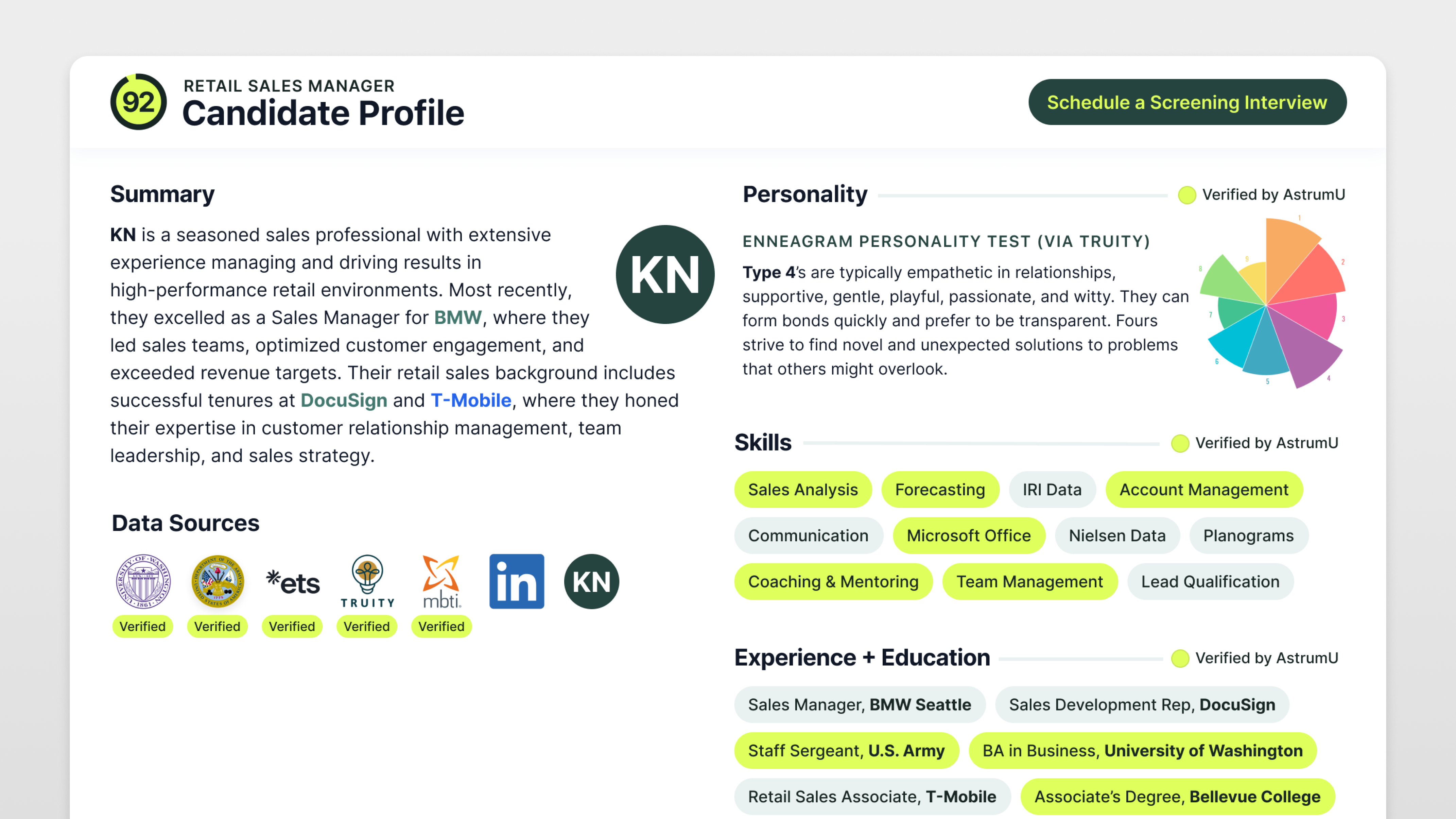
The unified profile was step 3–4 in the narrative arc, but it became the artifact that changed everything. It collapsed a person's fragmented data into a single view — skills, role-fit, gaps, and pathways — making the platform's value visible in a way no taxonomy diagram or heatmap could.
Before it, teams debated architecture and potential. After it, the conversation became: how do we get this in front of users? It also became the artifact leadership used for investor communications and customer positioning — not by design, but because it was the first thing that made the value self-evident.
AU Labs — Comparison View
Traditional Skills Output
Flat keyword list — no context, no confidence, no connections
AstrumU Skills Output
✓ Verified by AstrumUCross-referenced from role history + coursework
AU Labs as a forcing function
Building an interactive experience meant every team had to commit to specifics: what data comes in, what the output looks like, what the user does next, and what success means. Abstract roadmap items couldn't survive contact with a working demo.
The phased strategy: Phase 1 (Demo) — narrative arc, real user feedback. Phase 2 (Explore) — forward-looking design experiments to gain signal before committing engineering resources. Phase 3 — evolve into Skillset, a career mobility implementation that progressively replaced third-party integrations with AstrumU's own capabilities.
Candidate Profile
Jordan Davis
B.S. Business Admin · 4 yrs experience
Skills
✓ Verified by AstrumURole Fit
Gaps to Close
Pathways
Choosing career mobility as the wedge
With the unified profile as the anchor, we had to pick one use case to go deep on first. I made this call jointly with Product leadership:
- Education ROI — Connecting education outcomes to workforce data. Compelling in theory, but too many confounding variables, too long a feedback loop, and the institutions most likely to benefit were least equipped to act.
- Hiring efficiency — Skills profiles for better job matching. Viable, but narrow — positioned AstrumU as a feature inside someone else's workflow rather than a platform.
- Workforce planning — Understanding organizational skills inventory. Strong use case, but requires executive buy-in and long sales cycles. Became priority #2.
- Career mobility — Growth pathways for individuals, managers, and leaders based on verified skills. This won: the problem is self-evident to every stakeholder, three user types share one unified problem, and the profile is the career mobility tool.
Career Mobility — Three Stakeholders, One Problem
Employee
"Where can I go?"
See skills, gaps, and pathways — know what's possible and what to build next.
Manager
"How do I develop my people?"
Understand team skills, identify growth opportunities, have evidence-based development conversations.
Leader
"How do I retain and grow talent?"
Internal mobility metrics, retention signals, workforce readiness at scale.
No one needs the value explained — the problem is self-evident at every level.
Building the design practice in parallel
While the strategy and alignment work was happening, I built the design function from scratch:
Research as a standing practice. AstrumU had no qualitative research when I arrived. I embedded discovery and usability testing into how the team worked every sprint — not as a phase, but as a standing input.
Team structure and quality bar. Four designers across multiple product streams. I established critique cadences, design review processes, and quality standards so autonomous work stayed coherent.
Cross-functional working agreements. Explicit agreements with Product, Engineering, and Data Science on review timing, handoff mechanics, and decision authority. Replaced ad hoc coordination with predictable cadences.
AU Labs made the product's value visible. The research practice, critique cadences, and working agreements made quality repeatable. Neither works without the other. See the principle →
Outcomes
- Designed and shipped the unified profile — the artifact that aligned the company around a concrete product vision after months of abstract strategy discussion
- Led AU Labs from concept to the primary tool for internal alignment, investor communication, and customer positioning
- Made the career mobility focus call (jointly with Product) that gave the company a clear use case with multi-stakeholder value — deprioritizing education ROI and hiring efficiency to concentrate resources
- Built a 4-person design team with embedded research, critique cadences, and quality standards
- Founded the company's first qualitative research practice
- Created the product catalog, OKR/KPI frameworks, and Product Readiness Tracker that gave cross-functional teams shared language for planning and shipping
- Established working agreements across Product, Engineering, and Data Science that replaced ad hoc coordination with predictable review cadences
What this reveals about how I work
The most important thing I built wasn't a framework or a process — it was an artifact that made a complex platform immediately understandable. The unified profile worked because it answered the only question that mattered: what does this platform do for one person?
It's also a story about focus as a design leadership act. The platform could do many things. Picking the use case where the value was self-evident to every stakeholder meant we could stop explaining and start building.
What I'd do differently
- Would have pushed harder to kill the skills heatmap direction earlier. I let it run longer than I should have because it had internal momentum, and the time spent exploring it delayed the focus on individual-level value.
- The hybrid design–product role was necessary but ambiguous. Clearer role definition from the start would have reduced friction — not because the overlap was wrong, but because the authority boundaries needed to be explicit sooner.
- Would have delegated more design execution earlier to free up time for the alignment work that only I could do. I held onto craft longer than the situation warranted.
Next Project
Dooly →