AstrumU
From infrastructure-thinking to individual value — the narrative arc, single artifact, and operating frameworks that aligned a company around what its AI platform actually did.
Head of Design (hybrid design–product capacity) · 2024–2025 · 4-person design team
In a hybrid Head-of-Design role, built AU Labs as the company's narrative arc, shipped the unified profile as the proof artifact, and repositioned the product catalog with the operating stack underneath.
In this project: AU Labs · The Unified Profile · The product catalog
Head-of-Design IC work at three altitudes: creating design vision (AU Labs), building the artifact that made it actionable (the Unified Profile), and aligning workstreams around it (the product catalog).
AU Labs
Built a narrative + demo that aligned teams (and leadership) on what the platform did for one person.
Step 1: build the narrative arc. Drawing on product catalog work I'd done in earlier roles, I knew alignment had to start with a shared story — the artifact and the operating stack would come next.
The problem
the company was telling an infrastructure story (graph, taxonomy, heatmaps). It looked impressive, but it didn't answer the user question: "What do I do with this?"
What I built: AU Labs — a 6-step arc based on user questions.
- What problem are we solving? side-by-side comparison vs alternatives
- Why are we better? show downstream impact, not claims
- How does it work? reveal the Unified Profile
- What does the user do next? make the workflow concrete
- What's underneath? enough detail to build trust
- How does it fit into a real org? where it plugs into existing processes
Why it worked
It gave every team a shared "source of truth" artifact. Roadmap debates had to match the demo, so vague strategy couldn't survive contact with the product.
The Unified Profile
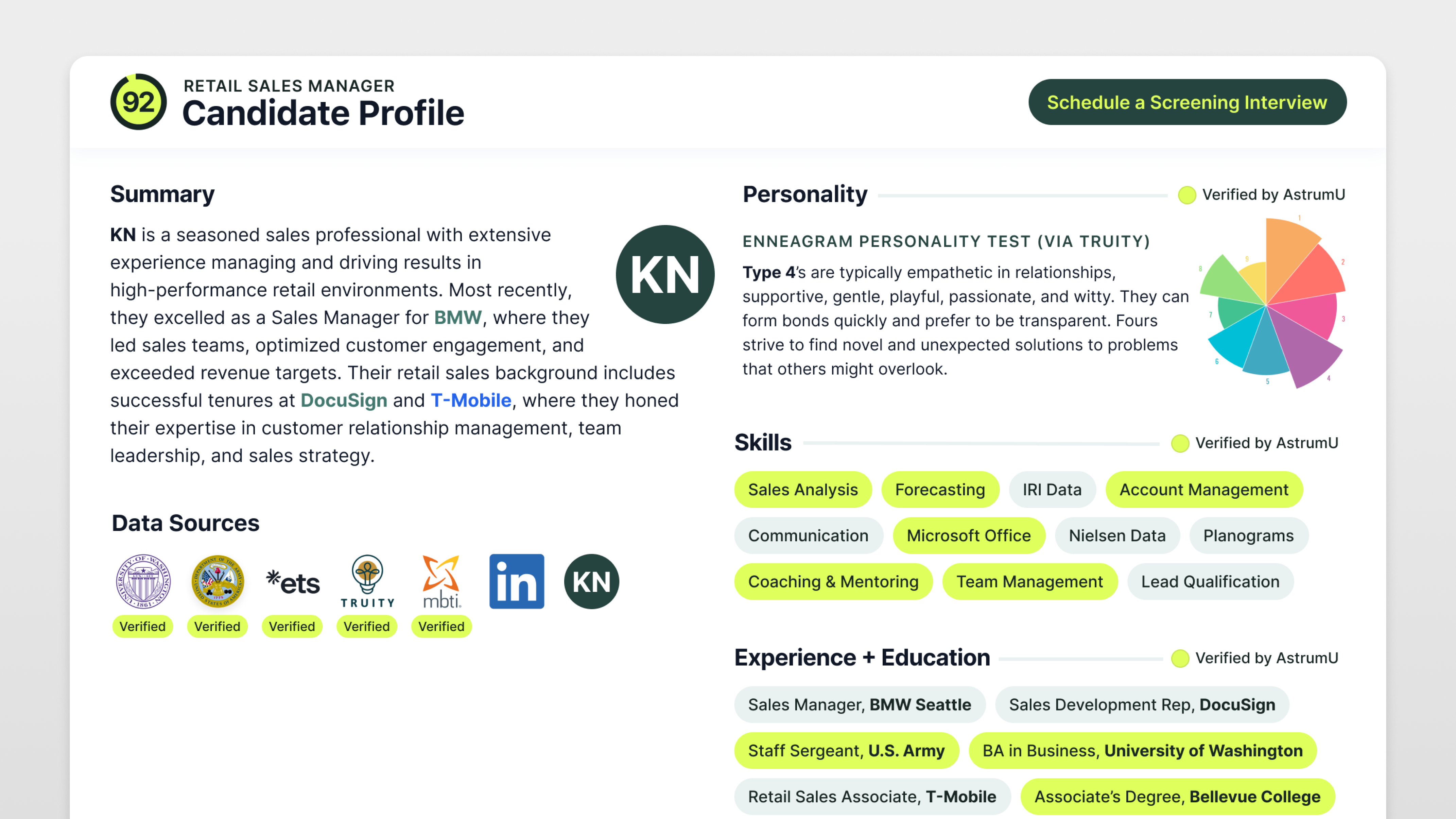
A single profile view that served three audiences — without turning into three dashboards.
Step 2: ship the proof artifact. The narrative arc gave teams a shared story; the next step was a single piece of evidence anyone could point at.
Skills data is dense and easy to misread. The Unified Profile made it usable for:
- an employee asking "Where can I go next?"
- a manager asking "Who's ready for what?"
- a leader asking "Do we have the skills to execute?"
Designed one profile view around one question: what can this person do today — and what could they do next?
- Grouped skills by domain (so it reads like a role conversation, not a spreadsheet)
- Showed "fit" as a match profile (strengths + gaps), not a single number
- Put AstrumU's structured skills next to keyword-based alternatives so the difference was obvious
- Used progressive disclosure: quick scan up top, details when you need them
Why it worked
the same view supports a 10-second scan and a deeper evaluation — without forcing each audience into a different starting point.
One view, one question
"what can this person do today — and next?"
The product catalog
Turned a messy set of "products" into a shared catalog + operating system teams could actually plan around.
Step 3: rebuild the operating layer. AU Labs aligned the company on the story. The Unified Profile aligned teams on the core artifact. The missing layer was the day-to-day: what gets shipped, who it's for, and how progress is measured.
The problem
the catalog had grown organically — capabilities, initiatives, and named products overlapped. Roadmap conversations got slow and cross-functional coordination stayed ad hoc.
What changed: a product catalog with clear definitions + a lightweight operating stack.
- Defined each product by who it serves, what job it does, and what stage it's in
- Mapped strategy to execution with OKRs/KPIs and a shared Product Canvas
- Rolled out a Product Readiness Tracker so Engineering, Data Science, Marketing, and Sales planned launches from the same surface
- Set explicit working agreements (review cadences, handoffs, and decision points)
Why it worked
it gave teams shared language across three altitudes — why (narrative), what (artifact), and how (catalog + operating stack) — so alignment didn't evaporate at sprint planning.
One catalog, one operating layer
from a set of microservices to a tiered Platform offering
What I'd do differently
- Killed the skills heatmap direction sooner. It had internal momentum and visual appeal — neither was a reason to keep exploring it once individual-level value was the real wedge. I let interest postpone the decision.
- Defined the hybrid design–product authority boundaries on day one. The overlap wasn't wrong; the ambiguity was. Explicit boundaries would have reduced friction without changing the role's substance.
- Delegated more craft work earlier. The alignment work was the thing only I could do, and I held onto execution longer than the situation warranted.
Full case study (Available upon request)
Next Project
Dooly →